The continuous thread that resonates our work is captured by a grassroots woman from the war zone.
“if there is poverty, there is no peace…
If there is violence, there is no peace…
If there is no space to write or breathe fresh air,
there is no PEACE…”
If there is violence, there is no peace…
If there is no space to write or breathe fresh air,
there is no PEACE…”
Discriminatory, cultural and patriarchal social systems such as formal and informal laws, social norms and practices shape or restrict the decisions, choices and behaviors of groups, communities and individuals and play an important role in determining opportunities and outcomes for women and subsequently development outcomes. Working with religious leaders in our efforts towards intra and inter faith initiatives and women’s rights issues is a big challenge. There was a need to further address our intra faith programmes to reflect the progressive interpretation of the religious teachings, education on social integration, pluralism, democracy and rights based development and justice for grassroots communities in the Eastern Province.
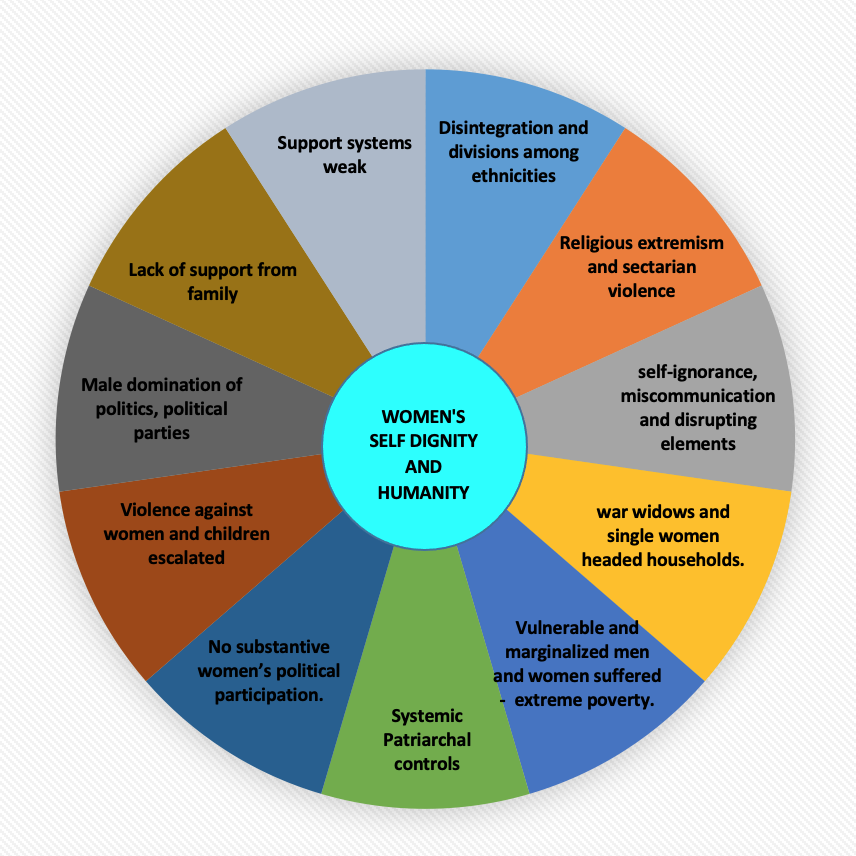
How can women reclaim their humanity, bring social justice?
Promoting Social Justice and Gender Equity for Democratic Culture and Social Change… The focus was on equipping men and women, 2,000 men, 3,500 women and 1,000 i.e. marginalized population from 28 identified villages in the Eastern Province, in the development sector with a broader and critical perspective on issues of sustainable development, to develop and build feminist capacities of a cadre of trainers through ‘training-of- trainers’. Develop a strong human rights outlook on development issues and also strengthen solidarity and networking, which assists local level trainers in their work and thus widen their viewpoints and skills.
- The Batticaloa Women’s Federation’s network for disappeared persons lobbied and demanded for international courts to inquire into the cases while an Office of Missing Persons (OMP) was in the process of being set up to look into the disappearances.
- The strengthened Migrant Network was invited to register with the Foreign Employment Bureau for direct intervention in prospective or returnee’s migrants’ welfare.
Significant achievements
Advocacy for rights, pluralism and peace:
Supported Batticaloa Women’s Federation (BWF) and Migrant Women`s Network to promote activities towards the building of a strong foundation of leadership skills and contribute to social change- transition by collaborating with multi-sectoral networks, networks, institutions and organizations at village and district levels. Initiatives raised public awareness to empower and created spaces for vulnerable women and girls, ensured sexual and reproductive health, reduced gender-based violence and secured social justice for democratic culture and social change.
Socio-Economic empowerment Women’s Groups/ Networks:
Marginalized women address the gender aspects of violence and conflict by tackling women’s poverty – networking and raising awareness on livelihood training and collectives and institutional strengthening. Existing networks were strengthened and upgraded beneficiaries’ livelihood management and capacities built for improved production, technology and larger markets. The established livelihood networks were supported to collaborate and introduce innovative financial education, savings and credit etc. for sustainable entrepreneurship and increased income generation. Linkages were facilitated with local level buyers, banking and marketing ventures to achieve optimal economic development outcomes.
Spinoffs
- Broad Advocacy initiatives – Strengthened Women’s groups have, in turn, provided capacity training to women and other groups as well as increased their participation and empowerment at the local level initiatives – action to prevent rubbish dumping, timely psychosocial referrals to hospitals, safe family reproductive health, promoting women’s participation in local institutions and elections, safe women’s migration avenues [migrant workers] etc. were direct interventions whenever required.
- Access local government funds – Through several meetings with Divisional Secretary (DS) and the Additional Divisional Secretary, BWF was successful in getting migrant women’s livelihood assistance for returnees from the district Samurdhi/Government funds. The Government Agent offered livelihood grants through the Sawiya Shakthi programme and pledged that shops that were being constructed at the Kallady market could be allotted to the BWF for marketing of village produce.
Rebuilding Relationships and Networks across Ethnic Lines for Social Cohesion, Peace and Stability
Ethnic conflicts, prejudice and hatred and the disintegration caused was accelerated by the war, impacted all ethnic communities with antagonism and suspicion. Each community (Tamil and Muslim) gave preference to its ethnicity over national interests and worked on communal lines. From our experiences working with Religious and Community Leaders towards interfaith harmony had positive outcomes, it was one of those good strategies to resolve ethnic strife which besets Eastern Sri Lanka. The ’people to people dialogues were promoted to revive community co-existence
- Intra and interfaith dialogues to minimize extremism and misconceptions and address potential malicious acts that prevalent when religion is misused. The creation of a conducive environment for all religions, promoting inter dependence of values of other faiths and to resolve important issues which in turn lead to a social cohesive culture. It was also an avenue for women and moderates to take the lead instead of remaining passive on interfaith dialogues.
- Peace building and conflict resolution; a Chinese delegation of religious leaders from the Chinese Congress of Religions for Peace (CCRP) invited MWRAF for a national dialogue together with its networking religious partners and individuals working on peace building and conflict mitigation. MWRAF’s efforts with the stimulation of spiritual values through contemporary initiatives of inter-intra faith dialogues were appreciated.
Gender equality and social change in empowering and strengthening communities and groups, building networks so that rights holders can support themselves and be empowered to understand how to claim their human rights and to protect rights activists.
Comments are closed.