“We listen, we learn, we search, we discuss, we plan, we support, before we act…. This is our path to open doors to get justice for affected women…”
MWRAF primarily addresses rights -issues of Muslim women marginalized by the system and their access to justice by working together with supportive women and men to expand our reach towards our vision. Since its inception, Muslim Family law counseling has been the cornerstone of MWRAFs indirect & direct advocacy, to reform the Muslim Personal Law.
Our pioneering focused work since 1986 has been on Muslim Personal Law reforms, its contents, its weaknesses, and procedural – implementation issues.
In 2000 MWRAF commenced a program to provide legal advice to affected women on matters relating to marriage, divorce, maintenance for wife and children, custody of children etc. to build their confidence to move forward with their lives. The understanding that informs our legal support/advice is not only to support affected –marginalized Muslim women but to also build their knowledge of the law, societal issues and to make life choices, to emancipate themselves.
The Approach –
- Linking action/research to MWRAF’s activism as a cohesive strategy, designed the Para legal counselors [barefoot counselors] training module,. Using a cascade approach, from basics to advance training and giving regular inputs to PLCs that they update their practical know- how to give needed support to women who seek advice.
- Over the years it has grown and expanded to cover not only cases in and around Colombo but also in other districts, reaching out to Muslim women in the interior towns and villages as well. Now the counselling service is decentralized with 14 Para Legal Counsellors (PLCs) working in 5 districts. MWRAF has handled more than 10,000 cases in various Quazi Courts, Board of Quazis, Court of Appeal, District Court, Magistrates Court, as well as the Supreme Court over last 10 years.
- The PLCs, also known as Barefoot counselors serve as intermediaries between the community women and the justice system, supporting and ensuring the affected women get justice. They work closely with the Quazi judges, linking the affected women and Quazi judges, building rapport and promoting a favorable environment for women and men to work together.
- In their extended role as PLCs, they also act as the field facilitators taking up other social rights violations/ issues at the local level.
MPL Advocacy framework
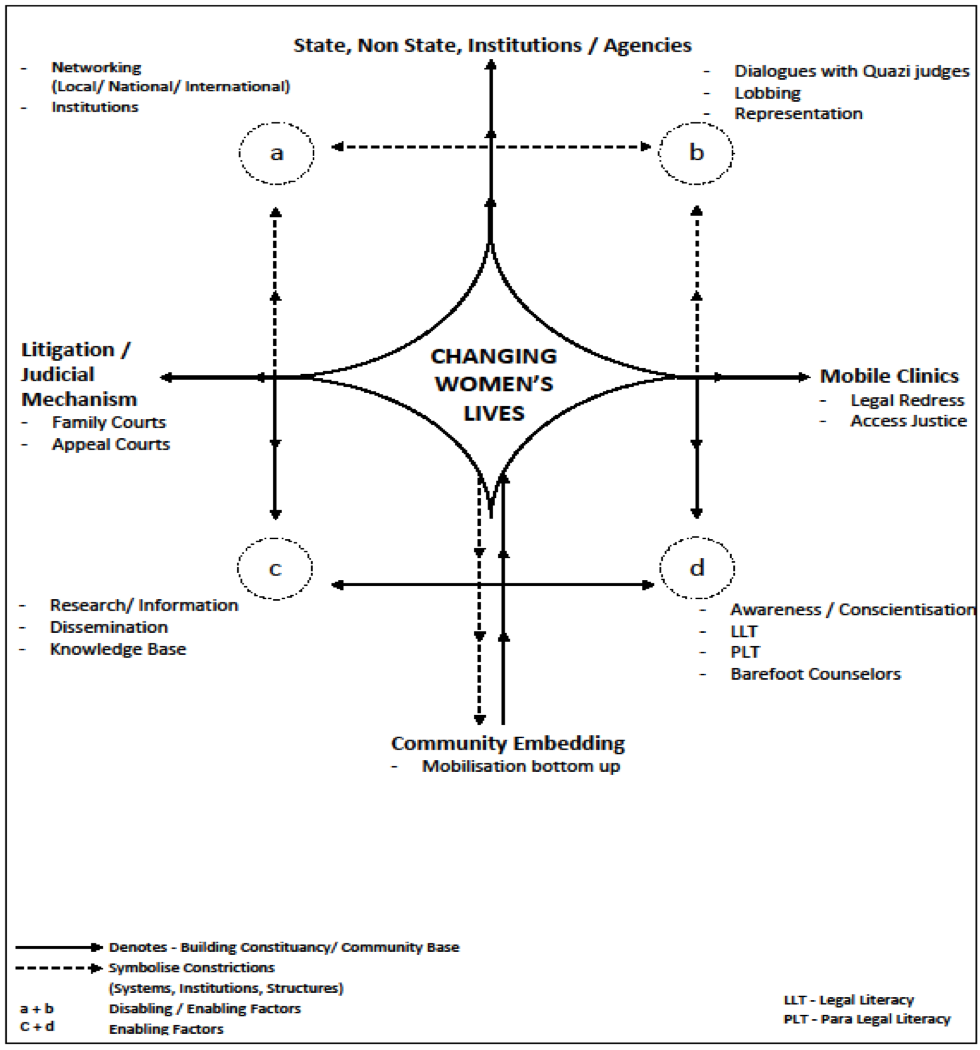
Our strategies:
- Promoting dialogues with Quazi judges across the country [ Code of ethics for Quazi judges]
- Conducting action research feeding into publications and designing user-friendly tools
- Training barefoot legal counselors cum field facilitators
- Organizing outreach mobile legal clinics at the community level
- Facilitating dialogues with diverse community supporters, including university students, media personnel, the Justice Services Commission, Board of Quazis, lawyers, and community leaders
- Taking cases on appeal at higher courts
- Representing in Muslim Personal Law reforms in 1986, 1990, 2009 & 2021
- Networking and global solidarity-support
Comments are closed.